



About the Department
The Department of Electrical Engineering has offered the Bachelor of Engineering Program in Electrical Engineering since 1967. At present, the department admits students to its Electrical Engineering programs at the bachelor’s, master’s, and doctoral levels. In 2007, it became the first institution in Southern Thailand to open an undergraduate program in Biomedical Engineering. In addition, an undergraduate program in Semiconductor Engineering was available for the first institution in Southern Thailand in 2025.
The Bachelor of Engineering Program in Electrical Engineering is also certified by the Council of Engineers allowing graduates to apply for dual certifications in Power Engineering and Telecommunications Engineering from the Council of Engineers.
The department emphasizes excellence in both teaching and research, as well as the integration of expertise in the following fields:
- Power Engineering
- Telecommunication Engineering
- Electronics Engineering
- Biomedical Engineering
- Semiconductor Engineering
Vision and Mission of the Department of Electrical Engineering
Vision
To produce graduates with both knowledge and integrity, and to generate academic work in Electrical engineering of international quality.
Mission
- To produce graduates at both undergraduate and graduate levels who are capable, skilled, ethical, and Electrical.
- To produce and disseminate academic work of international quality.
- To enhance the quality of teaching and learning.
- To promote academic services through collaboration with internal and external organizations.
Vision and Mission of Faculty of Engineering
Vision
Faculty of Engineering Leading the nation in producing engineers and creating innovations with international potential to develop the southern region and the country sustainably (Faculty of Engineering ranked 1 of 5 in the country in 2026)
Mission
- To produce engineers with good attitudes, have international knowledge and skills
- To create knowledge and innovation International Engineering for apply
- To academic service about engineering for strengthening the southern region and the country
Program Name
Bachelor of Engineering Program in Electrical Engineering
Degree Name
Bachelor of Engineering (Electrical Engineering)
Catalog Description
You can check up for detail Catalog Description
Program of Study
You can check up for detail Course Plan
Program Constituencies
The consistencies of our Electrical Engineering program comprise of:
- Graduates of the program (Alumni)
- Employers of the graduates
- Faculty (Curriculum Committee/Faculty Committee)
Program Learning Outcomes (PLOs)
Graduates of the Electrical Engineering Program will have attained the following outcomes by the time of graduation.
PL01 Demonstrate responsible behavior and work ethically and professionally
PL02 Apply knowledge in basic mathematics, sciences and engineering to solve problems
PL03 Solve complex problems related to electrical engineering by combining electrical engineering knowledge along with related fields
PL04 Learn how to improve and adapt to evolving technologies
PL05 Communicate with various groups in national and international languages
PL06 Work as a team with leadership and communication skills
PL07 Use digital technology to create media and contents conveying concepts and ideas appropriately
Student Admissions
The program admits students who have completed Mattayom 6 (Grade 12) or its equivalent. Applicants must meet the admission criteria through the Thai University Central Admission System (TCAS), which consists of four admission rounds as follows:
TCAS 1: Portfolio
This round considers portfolios, cumulative GPA (GPAX) from 5 semesters, and interviews for some projects. The faculty accepts students through various sub-projects, including:
- Projects for students with excellent academic performance
- Projects for Vocational Certificate students
- PSU Engineering Quota Project
- Luk Phra Ratcha Bida (Child of the Royal Father) Project
- Mongkhonsuk Scholarship Project
TCAS 2: Quota (14 Southern Provinces)
This round is open only to students from the 14 southern provinces of Thailand. In addition to the criteria from TCAS1, applicants are also required to submit central examination scores, such as A-Level scores.
TCAS 3: Admission
This round is for nationwide admissions conducted by the Council of University Presidents of Thailand (CUPT). It considers central examination scores, TGAT scores (Thai General Aptitude test), and TPAT3 scores (Engineering competency test).
Round 4: Direct Admission
This is the final direct admission round for the Faculty of Engineering. The number of admissions in this round is set lower than in other rounds to reserve spots for students who lost their academic status in previous years or students who have not yet found an institution. To maintain admission standards, the faculty requires specific cumulative GPA qualifications, portfolio submission, and interviews.
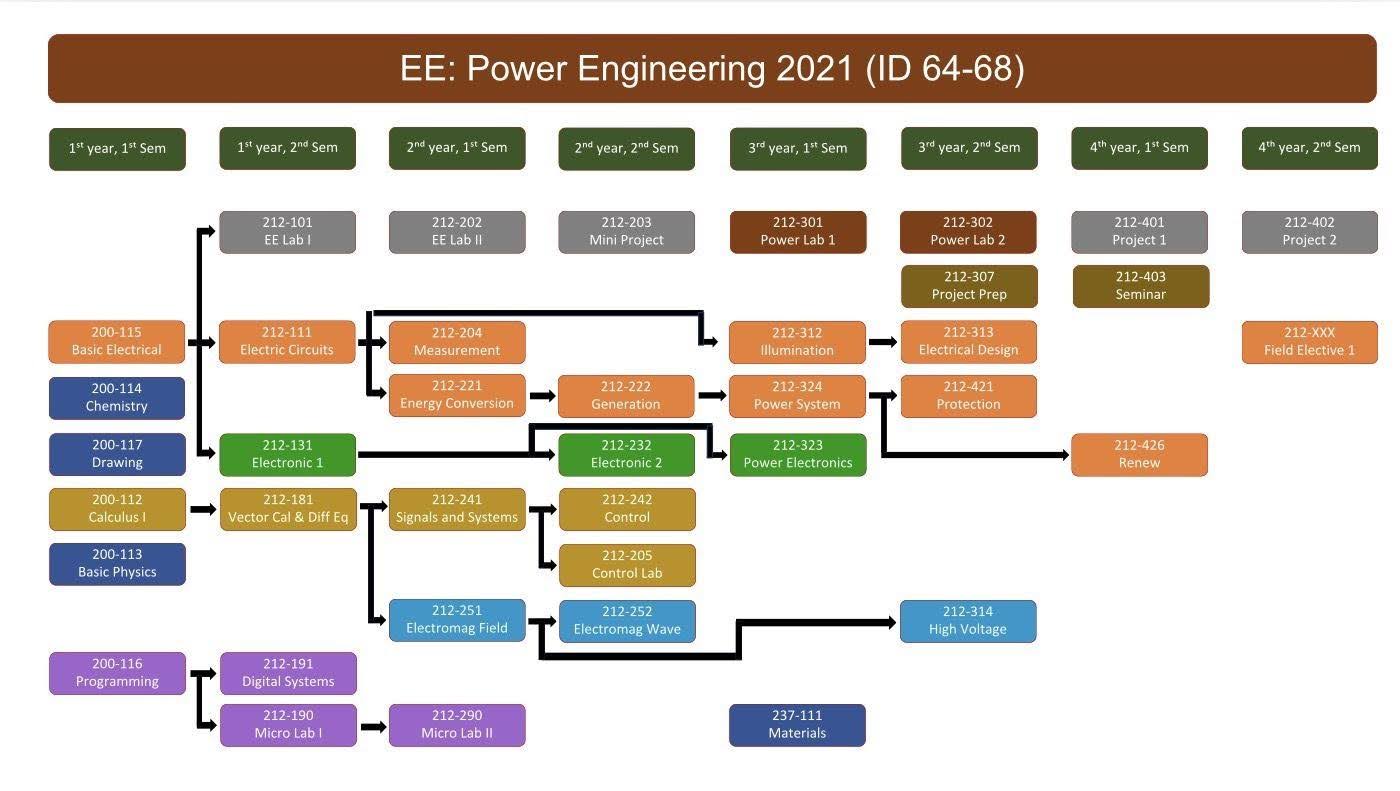
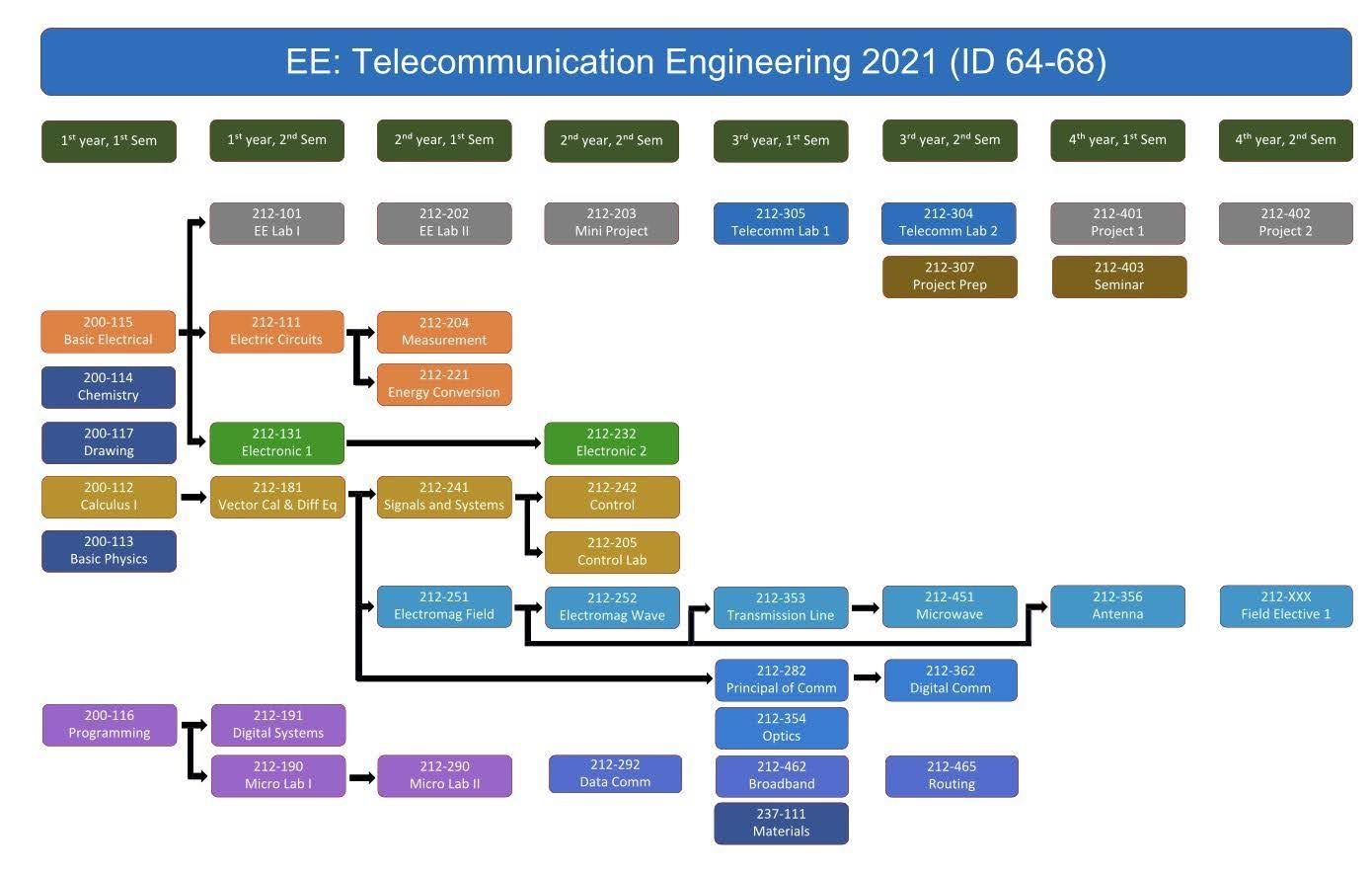
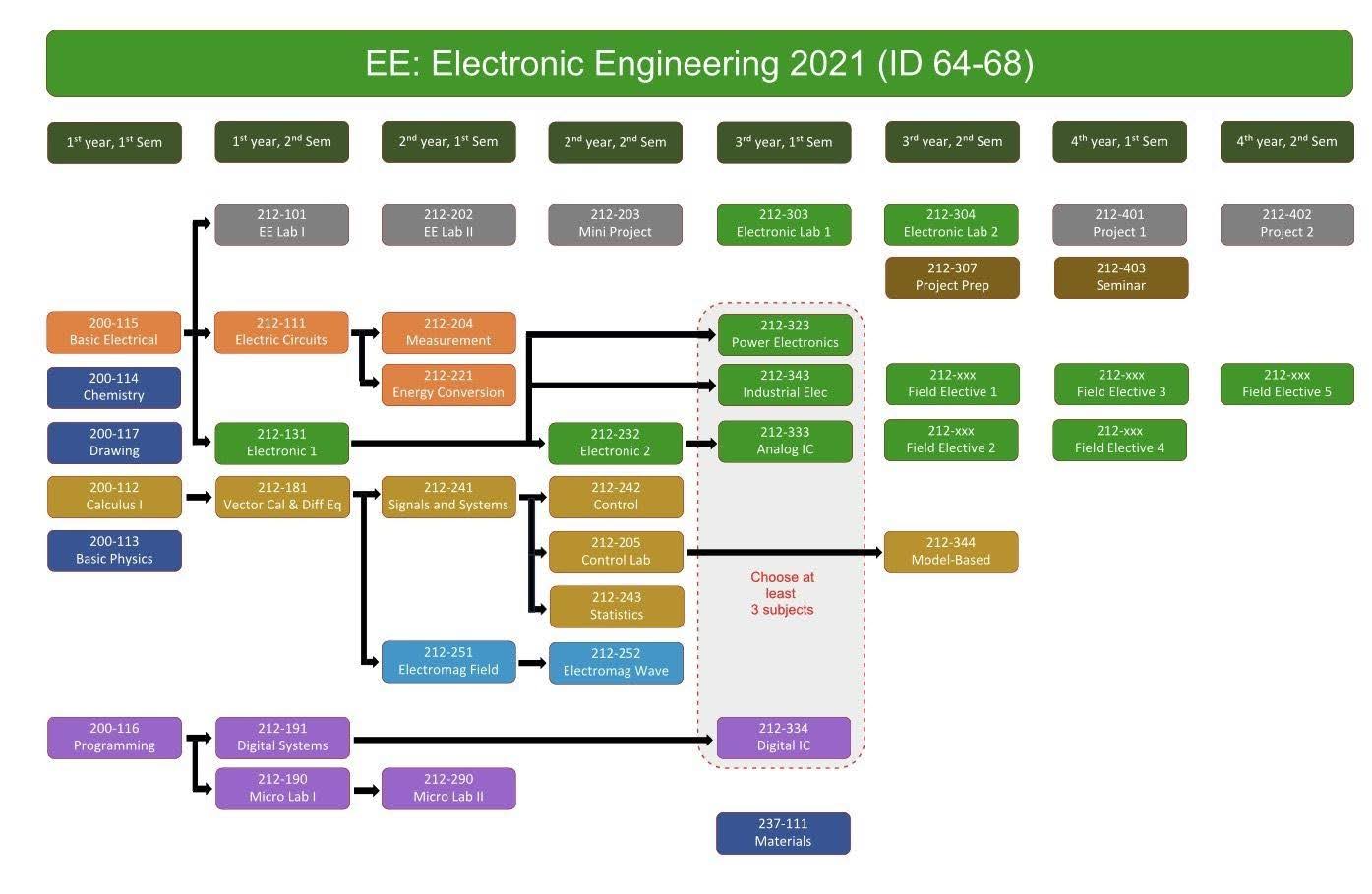
Curriculum Map
Graduation Criteria
In order to graduate from the Electrical Engineering Program, Prince of Songkla University, a graduating student has to fulfill all of the following requirements listed below.
- Complete and pass all the courses as required by our program (148 credits)
- Achieve minimum Engineering cumulative GPA of 2.00.
- Pass the English language proficiency assessment criteria announced by Prince of Songkla University.
- Participate in and Electrical all extra-curricular activities as required by Prince of Songkla University.
- Electrical an internship of not less than 320 hours and pass the courses Computer Engineering Project I and Electrical Engineering Project II (for students who choose the Internship and Project Plan).
- Electrical a cooperative education placement in an industrial establishment (for students who choose the Cooperative Education Plan).
Program Accreditation
The program is scheduled to undergo an evaluation for accreditation by AUN-QA International during January 26–28, 2027.